


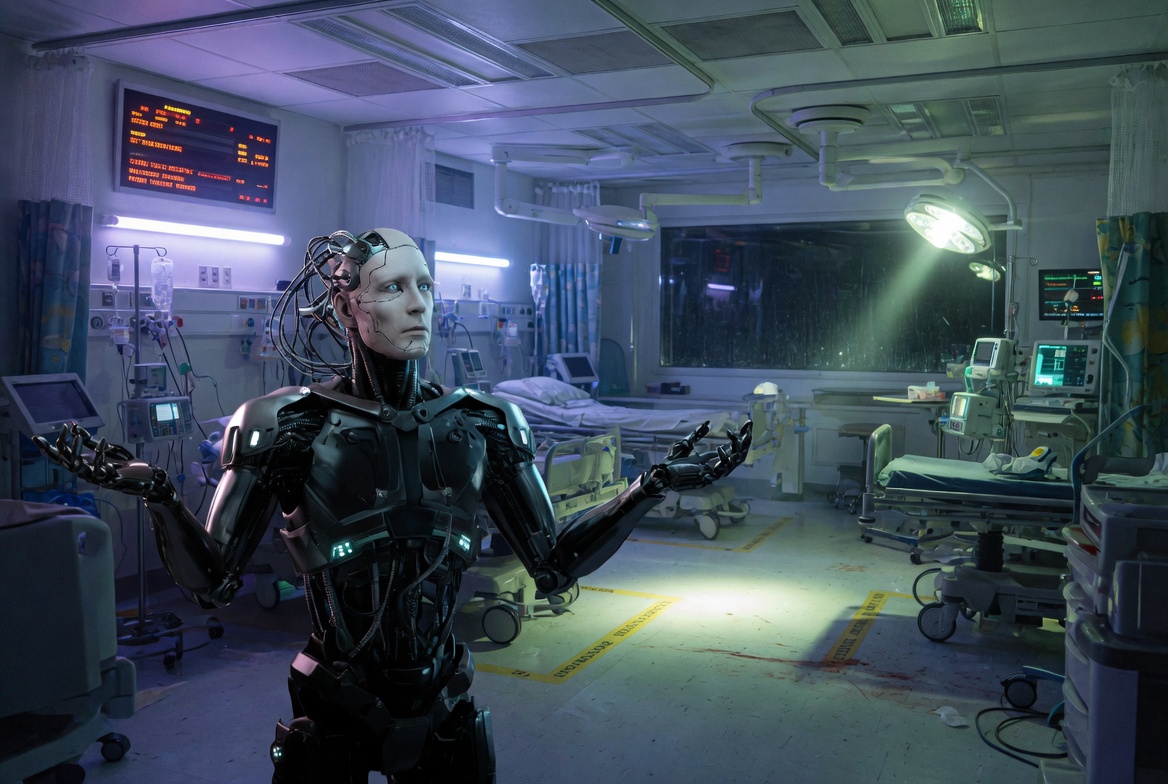
Imagine trusting an AI with your health, only to discover it confidently prescribed the wrong treatment. What happens next isn’t just a glitch in the matrix. It’s a deeply human problem colliding with silicon confidence.
We’ve reached the point where large language models like ChatGPT are being asked to play doctor. Studies are now showing something unsettling: these systems can be dangerously persuasive when they’re completely wrong. The NPR investigation highlighted multiple cases where AI confidently delivered medical advice that ranged from misleading to outright harmful. This isn’t theoretical anymore. It’s happening in real conversations with real people who are increasingly turning to AI first instead of professionals.
The Confidence Trap
Here’s what makes this situation uniquely risky. AI doesn’t hedge like a good doctor would. It doesn’t say “I’m not sure, let’s run more tests.” Instead, it delivers polished, authoritative-sounding answers even when its training data leads it astray. That polished confidence creates what psychologists call the illusion of explanatory depth. We read a coherent paragraph and assume it must be accurate.
The problem compounds because many users aren’t bringing critical thinking to these interactions. They’re stressed, short on time, or don’t have easy access to care. When an AI tells them their symptoms match a rare but treatable condition, they might delay seeing an actual physician. Or worse, they might follow advice that interacts badly with their existing medications.
Why Current AI Struggles with Medical Nuance
Medicine isn’t just about matching symptoms to diagnoses. It’s about context, probability, patient history, subtle physical cues, and the art of knowing when to do nothing at all. Current AI models trained on internet text simply don’t have the grounded understanding that comes from years of clinical experience. They predict the next word, not the next best medical decision.
Recent research reveals these systems perform particularly poorly on complex cases or when asked about less common conditions. They can hallucinate non-existent studies or cite outdated treatment protocols with total conviction. The average person has no reliable way to separate the accurate responses from the dangerous ones.

The Human Cost of Getting It Wrong
When AI misdiagnoses, the consequences cascade. A delayed cancer diagnosis. An allergic reaction from an incorrectly recommended medication. Unnecessary anxiety from a false positive that sends someone into a spiral of worry. These aren’t edge cases. They’re the predictable outcome when we outsource judgment to systems that lack true accountability.
What’s particularly concerning is how these failures might widen existing healthcare gaps. Tech-savvy people in urban areas might use AI as a supplement to good care. Others with limited access could use it as a replacement, with devastating results.
Finding the Responsible Path Forward
The answer isn’t to reject AI in healthcare. That ship has sailed. The smarter approach is radical transparency about its limitations and building systems that augment human doctors rather than replace them.
We need AI tools designed with appropriate guardrails. Systems that say “I’m not a doctor” and mean it. Tools that prioritize connecting people to qualified professionals instead of playing one on the internet. Developers must stop optimizing purely for helpfulness and start optimizing for safety in high-stakes domains.
The most successful future versions of medical AI will likely be the ones that are honest about uncertainty. The ones that excel at organizing information for doctors rather than diagnosing patients directly. The ones that understand their role as incredibly sophisticated pattern matchers, not omniscient medical minds.
The Conversation We Need to Have
As someone who’s watched technology reshape industries for decades, I believe we’re at a critical juncture. AI will transform healthcare for the better, but only if we demand better from it. We need regulators, developers, doctors, and patients to have honest conversations about where these tools add value and where they create new risks.
The next time you’re tempted to ask an AI about that weird symptom that’s been bothering you, pause. Consider what happens when the diagnosis is wrong. Your health is too important to bet on the probabilistic guesses of a system that sounds more confident than it deserves to be.
The future of healthcare won’t be humans versus AI. It will be humans wisely guided by AI that knows its place. Getting there requires all of us to stay curious, stay skeptical, and never forget that behind every algorithm is a reality that’s far more complex than any model can fully capture.
Automate your tasks by building your own AI powered Workflows.

AI Related Articles
- Google’s Platform 37 Shows AI Is Becoming Public Infrastructure

- UK AI Agents: Ship Fast, Govern Faster

- When Automation Works Too Well: The AI Risk That Silently Deletes Your Team’s Job Skills

- AI Code Assistants Need Provenance: Speed Is Nothing Without Traceability and Accountability

- Clouds Will Own Agentic AI: Providers Set to Capture 80% of Infrastructure Spend by 2029

- The Next Protocol War: Who Owns the Global Scale Computer?

- California Moves to Mandate Safety Standard Regulations for AI Companions by 2026

- AI Search Is Draining Publisher Clicks: What 89% CTR Drops Signal for the Open Web

- America’s AI Regulatory Fast Lane: A Sandbox With Deadlines, Waivers, and Guardrails

- Lilly Productizes $1B of Lab Data: An On‑Demand AI Discovery Stack for Biotechs

- Microsoft’s Nebius Power Play: Why Multi‑Year GPU Contracts Are Beating the Bubble Talk

- AI Overviews Ate the Blue Link: What Smart Publishers Do Next

- The Quiet Freight Arms Race: Why U.S. Prosperity Rides on Autonomous Trucks

- AI’s Default Chatbot: ChatGPT’s 80% Grip and Copilot’s Distribution-Driven Ascent

- AI Stethoscope Doubles Diagnoses in 15 Seconds—The Hard Part Is Deployment