


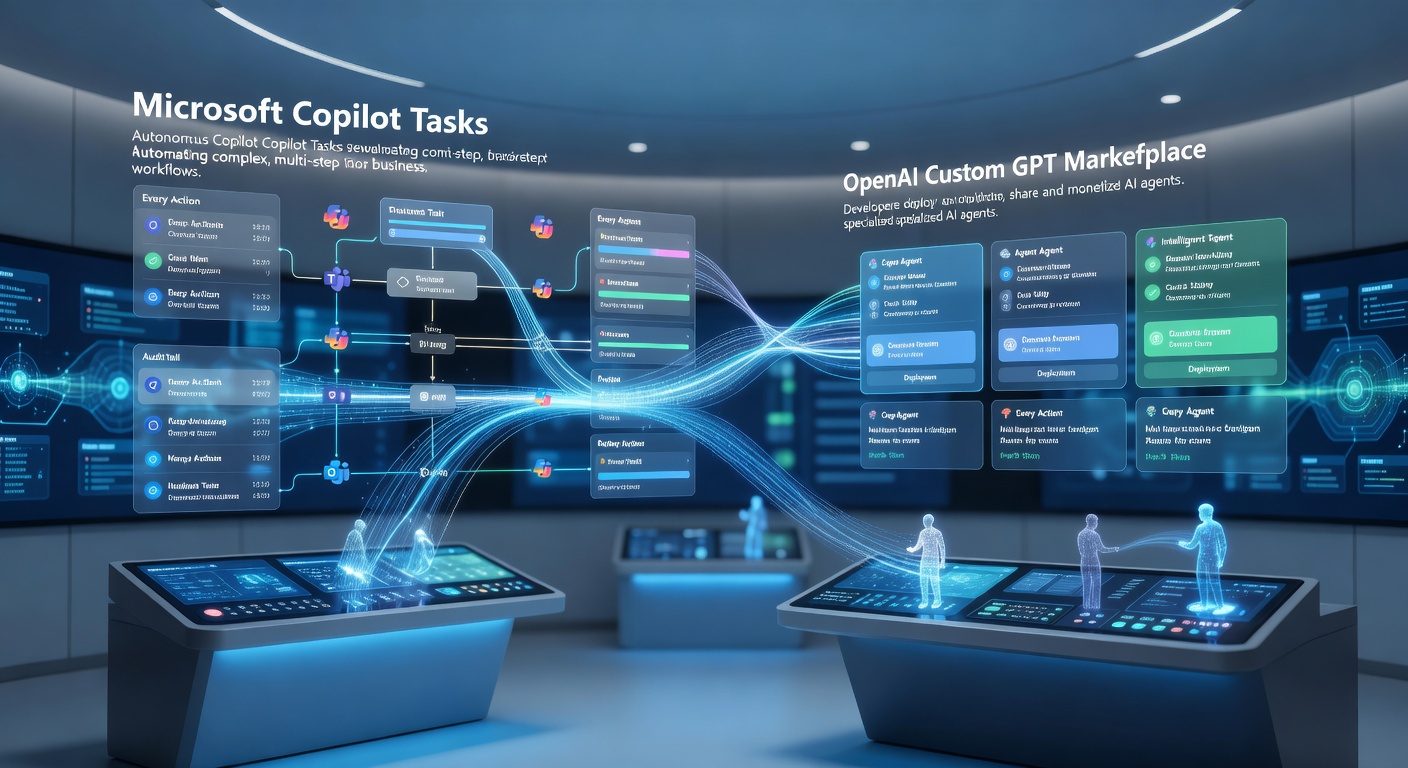
The age of passive AI is officially over. What we’re witnessing right now with Microsoft’s Copilot Tasks and OpenAI’s expanding Custom GPT Marketplace isn’t just an incremental upgrade — it’s the first clear signal that agentic AI has moved from science fiction into daily workflow reality.
For years we’ve played with chatbots that answered questions. Now we’re handing them actual responsibilities. Copilot Tasks lets users create persistent, goal-oriented agents that can break down complex projects, manage timelines, coordinate across tools, and follow up without being micromanaged. At the same time, OpenAI’s marketplace is turning into a bustling digital bazaar where anyone can publish, discover, and deploy specialized agents built by creators worldwide.
This combination is powerful because it attacks two different sides of the same problem: infrastructure and distribution.
Microsoft is focusing on depth and integration.
By embedding agentic capabilities directly into the Microsoft 365 ecosystem, Copilot Tasks can actually do meaningful work inside the apps millions already use — Excel, Outlook, Teams, and PowerPoint. It’s not flashy, but it’s practical. Your agent can monitor a project dashboard, chase down missing deliverables, summarize meeting notes into action items, and even draft the follow-up email — all while you focus on higher-order thinking.
OpenAI, by contrast, is betting on breadth and creativity. The Custom GPT Marketplace creates a true network effect. Independent builders are already shipping agents that act as personal fitness coaches, legal contract reviewers, climate impact analysts, or niche industry researchers. The best ones will spread virally. The mediocre ones will disappear. This Darwinian dynamic is exactly how transformative platforms mature.
What surprises most people is how quickly the quality curve is bending upward.
Early agents were brittle and needed constant hand-holding. The newest versions remember context across days, adapt when plans change, and even know when to ask for clarification instead of guessing. We’ve crossed an invisible threshold where these tools stopped being clever toys and started functioning like surprisingly competent digital colleagues.
There’s also an important environmental and economic angle worth considering. Better agentic systems mean fewer wasted hours, fewer unnecessary meetings, and dramatically lower human-driven computing overhead. When an agent can optimize a supply chain route or energy consumption model in minutes instead of days, the planetary upside becomes real. The winners in this space won’t just be more productive — they’ll be more responsible with both time and resources.

Of course, this new reality brings fresh questions.
Who owns the output when an agent creates something remarkable? How do we build trust frameworks for agents that act on our behalf? And what happens to careers when parts of knowledge work become commoditized at lightning speed?
The most successful founders and creators I know aren’t panicking. They’re experimenting daily. They’re building their own small fleets of agents, learning their quirks, and discovering where human judgment still beats silicon every time.
The agentic revolution isn’t coming. It’s here — and it’s remarkably fun to watch unfold.
AI Related Articles
- EU AI Act Enforcement Begins: What the New Regulatory Era Really Means for Innovation

- Google’s Gemini Pro 2 Just Changed the Game: What It Really Means

- OpenAI’s GPT-5 Turbo Just Dropped: Smarter Reasoning, Lightning Speed, and What It Really Means

- Why Apple’s Private Cloud Compute and AWS Bedrock Just Changed the Enterprise AI Game

- Open-Source AI Just Leveled Up: What Hugging Face’s Diffusion Hub and Stanford’s FALCON-X Really Mean

- Why Microsoft Copilot Tasks and the OpenAI GPT Marketplace Just Changed Everything About Agentic AI

- Google’s Gemini Ultra 2 vs Meta’s Llama 4 80B: The New AI Arms Race Just Got Interesting

- Google’s Platform 37 Shows AI Is Becoming Public Infrastructure

- UK AI Agents: Ship Fast, Govern Faster

- When Automation Works Too Well: The AI Risk That Silently Deletes Your Team’s Job Skills

- AI Code Assistants Need Provenance: Speed Is Nothing Without Traceability and Accountability

- Clouds Will Own Agentic AI: Providers Set to Capture 80% of Infrastructure Spend by 2029

- The Next Protocol War: Who Owns the Global Scale Computer?

- California Moves to Mandate Safety Standard Regulations for AI Companions by 2026

- AI Search Is Draining Publisher Clicks: What 89% CTR Drops Signal for the Open Web