


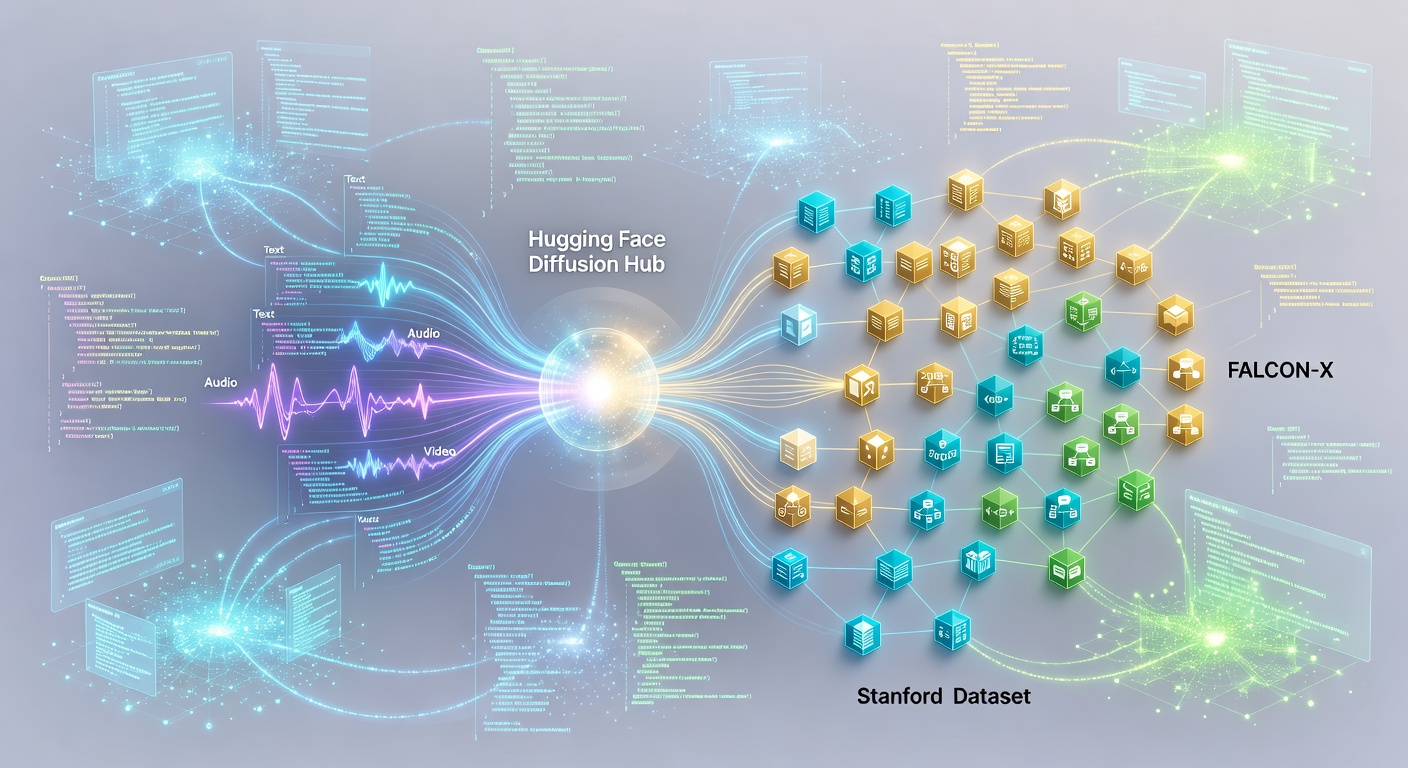
The pace of AI advancement isn’t slowing down. It’s accelerating in the open. While many still picture secretive labs hoarding breakthroughs behind closed doors, two recent moves show the real momentum is happening in public, collaborative spaces. Hugging Face’s new Diffusion Hub and Stanford’s release of FALCON-X are perfect examples. Together they signal something important: high-performance generative AI is becoming more accessible, more transparent, and frankly more fun than ever.
Why Diffusion Hub Changes the Game
Hugging Face has essentially built a one-stop creative powerhouse for diffusion models. Instead of hunting across scattered repositories or wrestling with inconsistent setups, developers and creators now have a centralized place to discover, fine-tune, and deploy state-of-the-art image and video generation models.
What makes this special isn’t just convenience. It’s the removal of friction. Artists, indie hackers, researchers, and enterprises can now experiment at the speed of thought. The hub lowers the barrier so dramatically that a clever side-project idea can move from concept to working prototype in hours instead of weeks. That speed creates unexpected innovation. When tools get this fluid, creativity compounds.
Stanford’s FALCON-X Raises the Intelligence Bar
At the same time, Stanford dropped FALCON-X, a powerful new open model family that pushes performance boundaries while keeping everything fully transparent. The release isn’t just another incremental improvement. It demonstrates that top-tier research institutions are choosing openness as a deliberate strategy rather than an afterthought.
FALCON-X brings stronger reasoning capabilities and efficiency improvements that make advanced AI practical on more modest hardware. This matters. When powerful models can run effectively without requiring warehouse-sized clusters of GPUs, the playing field widens. Students, startups in developing regions, and environmentally conscious teams all benefit.

The Surprising Power of Radical Openness
Here’s the contrarian truth most corporate AI strategies miss: sharing your best work often accelerates progress faster than guarding it. Every researcher who builds on Diffusion Hub or improves FALCON-X feeds the entire ecosystem. Bugs get fixed publicly. Techniques spread instantly. Safety concerns surface earlier because more eyes examine the code.
This collaborative flywheel creates a different kind of competitive advantage, one built on velocity and community rather than secrecy. The organizations and individuals who understand this are positioning themselves at the center of an exploding network of talent and ideas.
Environmental and Economic Reality Check
Running massive AI systems carries real costs, both financial and environmental. Open models like FALCON-X that deliver strong results with better efficiency help address both concerns. When you can achieve impressive results with less compute, you spend less money and consume fewer resources. That combination of fiscal responsibility and environmental awareness should appeal to any thoughtful leader in tech today.
The beauty of these developments is they don’t require choosing between performance and principles. You can have cutting-edge capabilities while staying conscious of your carbon footprint and burn rate.
What This Means for Builders and Creators
The message is clear. The age of waiting for big tech to hand down polished AI products is fading. The new era belongs to those who engage directly with the open ecosystem. Whether you’re a founder prototyping your next product, a creator exploring new mediums, or a researcher chasing novel applications, the tools have never been more capable or more accessible.
The combination of Hugging Face’s Diffusion Hub and Stanford’s FALCON-X represents more than two separate releases. They reflect a maturing open-source AI movement that is delivering production-grade innovation at remarkable speed.
The only real question left is how quickly you’ll start experimenting.
AI Related Articles
- EU AI Act Enforcement Begins: What the New Regulatory Era Really Means for Innovation

- Google’s Gemini Pro 2 Just Changed the Game: What It Really Means

- OpenAI’s GPT-5 Turbo Just Dropped: Smarter Reasoning, Lightning Speed, and What It Really Means

- Why Apple’s Private Cloud Compute and AWS Bedrock Just Changed the Enterprise AI Game

- Open-Source AI Just Leveled Up: What Hugging Face’s Diffusion Hub and Stanford’s FALCON-X Really Mean

- Why Microsoft Copilot Tasks and the OpenAI GPT Marketplace Just Changed Everything About Agentic AI

- Google’s Gemini Ultra 2 vs Meta’s Llama 4 80B: The New AI Arms Race Just Got Interesting

- Google’s Platform 37 Shows AI Is Becoming Public Infrastructure

- UK AI Agents: Ship Fast, Govern Faster

- When Automation Works Too Well: The AI Risk That Silently Deletes Your Team’s Job Skills

- AI Code Assistants Need Provenance: Speed Is Nothing Without Traceability and Accountability

- Clouds Will Own Agentic AI: Providers Set to Capture 80% of Infrastructure Spend by 2029

- The Next Protocol War: Who Owns the Global Scale Computer?

- California Moves to Mandate Safety Standard Regulations for AI Companions by 2026

- AI Search Is Draining Publisher Clicks: What 89% CTR Drops Signal for the Open Web