


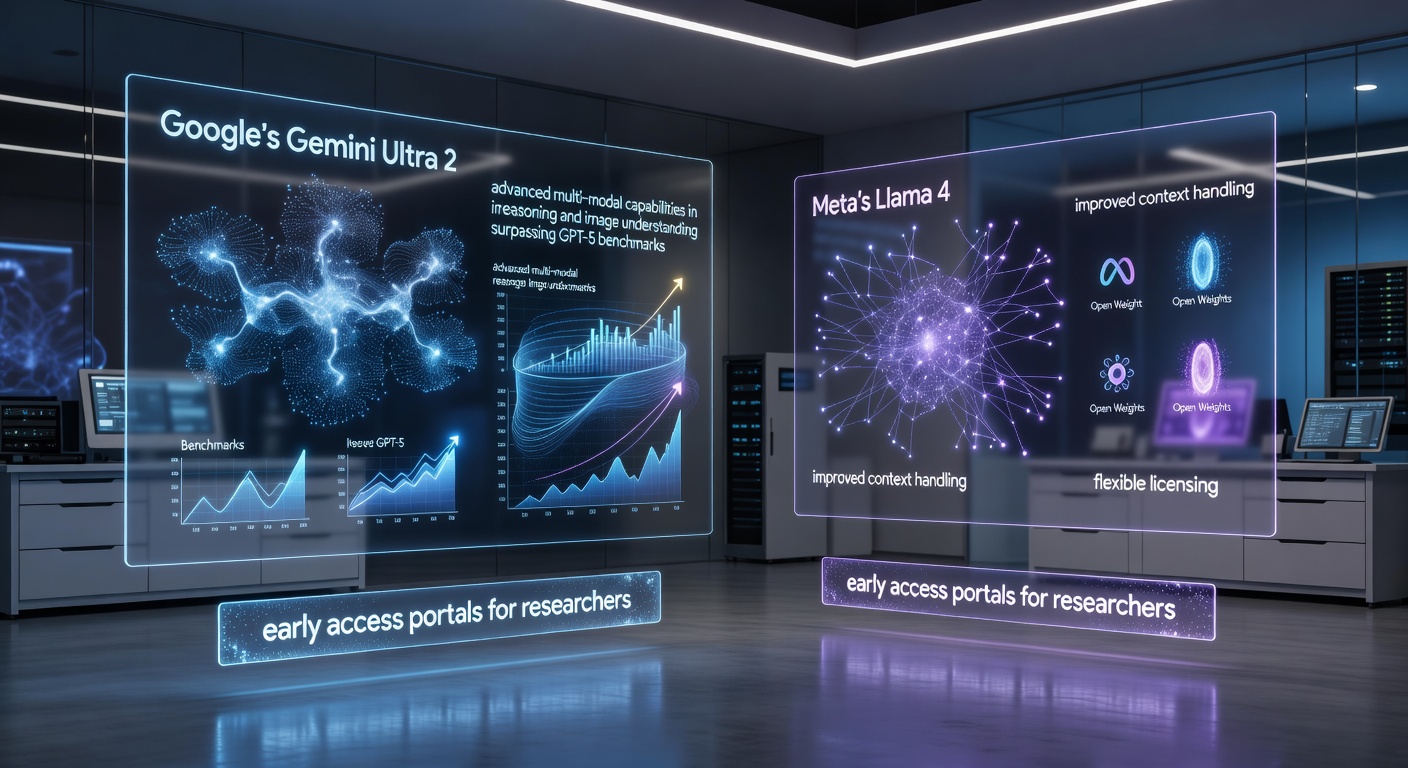
The AI frontier just moved again. In the span of a few weeks, Google dropped Gemini Ultra 2 and Meta pushed forward with Llama 4 80B, two models that aren’t just incremental upgrades—they represent fundamentally different philosophies about where AI should go next.
What makes this release cycle different is the sheer speed and the very public contrast in approach. While one company bets on massive scale, closed systems, and integration into its existing empire, the other doubles down on openness, efficiency, and letting the community run wild. The result? A genuine fork in the road for the future of frontier AI.
Why Size Still Matters—But Maybe Not How You Think
Gemini Ultra 2 reportedly pushes the parameter count into territory that makes previous models look quaint. The performance jumps in reasoning, especially on complex multi-step problems, are hard to ignore. Google has clearly focused on making the model better at sustained thinking rather than just faster pattern matching.
Yet here’s where it gets surprising: early benchmarks suggest Meta’s Llama 4 80B is punching well above its weight class. By focusing on smarter architecture and training techniques rather than simply throwing more parameters at the problem, Meta appears to have found performance gains that challenge the “bigger is always better” narrative. This isn’t just clever marketing—it’s a meaningful shift in how we think about efficiency in AI development.
The Open vs Closed Debate Enters a New Chapter
The most fascinating part of this matchup isn’t the raw capabilities. It’s the completely different paths these companies have chosen for how the technology gets used.
Google continues building what many see as the ultimate integrated AI assistant, deeply connected to Search, YouTube, Android, and enterprise tools. The strategy is clear: create something so capable and embedded that it becomes invisible infrastructure.
Meta, by contrast, continues its aggressive open-source push. Releasing Llama 4 80B with relatively permissive weights means researchers, startups, and tinkerers worldwide can build on it immediately. This creates a different kind of innovation flywheel—one that relies on thousands of creative minds rather than a single company’s roadmap.

What This Means for the Environment and Your Bottom Line
Both releases show increasing attention to something the industry has long ignored: real resource consciousness. Training and running these models requires enormous energy. The interesting twist is that efficiency improvements aren’t just good for the planet—they’re becoming a competitive advantage.
Smaller, smarter models that deliver comparable results while using dramatically less compute aren’t just environmentally responsible. They’re fiscally responsible too. Companies that master this balance may ultimately win, not because they’re more virtuous, but because they understand the economics of AI at scale.
The next few months will be telling. Will developers flock to the open Llama ecosystem and create applications we haven’t imagined? Or will Gemini Ultra 2’s superior reasoning capabilities and seamless integration make it the default choice for serious work?
One thing is certain: the age of waiting for AI to mature is over. These new frontier models are forcing every business, creator, and technologist to reconsider their assumptions about what’s possible right now.
The real winners won’t necessarily be the ones with the biggest models. They’ll be the ones who best understand how to apply these new capabilities in ways that actually matter.
AI Related Articles
- EU AI Act Enforcement Begins: What the New Regulatory Era Really Means for Innovation

- Google’s Gemini Pro 2 Just Changed the Game: What It Really Means

- OpenAI’s GPT-5 Turbo Just Dropped: Smarter Reasoning, Lightning Speed, and What It Really Means

- Why Apple’s Private Cloud Compute and AWS Bedrock Just Changed the Enterprise AI Game

- Open-Source AI Just Leveled Up: What Hugging Face’s Diffusion Hub and Stanford’s FALCON-X Really Mean

- Why Microsoft Copilot Tasks and the OpenAI GPT Marketplace Just Changed Everything About Agentic AI

- Google’s Gemini Ultra 2 vs Meta’s Llama 4 80B: The New AI Arms Race Just Got Interesting

- Google’s Platform 37 Shows AI Is Becoming Public Infrastructure

- UK AI Agents: Ship Fast, Govern Faster

- When Automation Works Too Well: The AI Risk That Silently Deletes Your Team’s Job Skills

- AI Code Assistants Need Provenance: Speed Is Nothing Without Traceability and Accountability

- Clouds Will Own Agentic AI: Providers Set to Capture 80% of Infrastructure Spend by 2029

- The Next Protocol War: Who Owns the Global Scale Computer?

- California Moves to Mandate Safety Standard Regulations for AI Companions by 2026

- AI Search Is Draining Publisher Clicks: What 89% CTR Drops Signal for the Open Web